

1. Let White Create a Clean Minimalist Kitchen Palette
If you search for images of minimalist kitchens, white is almost always the dominant color you’ll see. It’s clean, crisp, and pairs with nearly any material or finish, which is exactly why it remains the starting point for so many minimalist kitchen designs. Starting with a white base makes it easier to keep a kitchen looking uncluttered, since white surfaces show visual noise more quickly than darker tones, which naturally pushes you toward keeping countertops clear.
White also reflects light exceptionally well, which matters in Bangkok condos where natural light can be limited by neighboring buildings. A bright white kitchen tends to feel larger and more open than the same layout finished in a darker tone. Our white kitchen cabinets guide goes deeper into shade selection and finishes if this is the direction you’re leaning.
2. Make a Bold Color Statement Instead
Minimalist doesn’t have to mean colorless. In fact, a fully committed black kitchen can be just as minimalist as an all-white one, the key isn’t the color itself, it’s restraint in how many colors and finishes you introduce.
If white feels too neutral for your taste, choosing one bold color, a deep green, charcoal, or navy, and using it consistently across cabinets or a single wall creates a strong minimalist statement without tipping into visual clutter. The mistake to avoid is mixing multiple bold colors or patterns, which quickly undoes the calm effect minimalism is built on. Our black kitchen design ideas guide shows how a monochromatic dark palette can be just as restrained as an all-white one.
3. Let Natural Materials Do the Talking
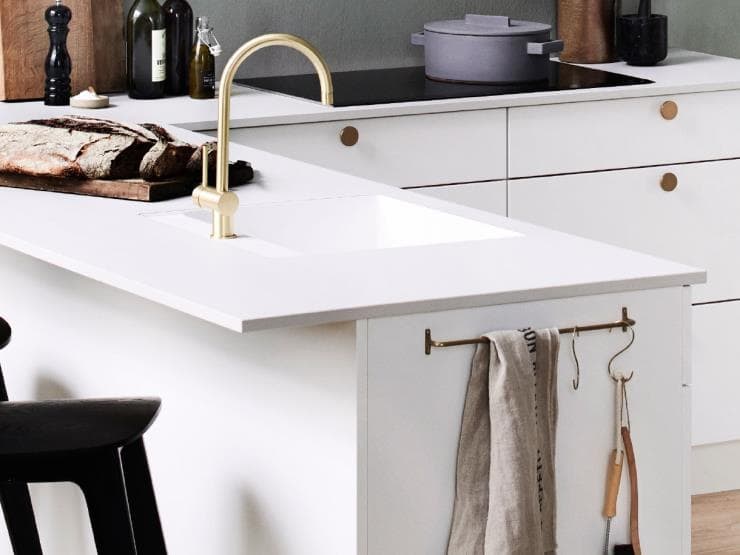
Minimalist kitchen design isn’t about being plain, it’s about letting fewer materials do more visual work. A marble countertop can become the natural focal point of the room precisely because there’s little else competing for attention around it. If low maintenance matters more to you than marble’s veining, quartz or granite deliver a similarly clean look with far less upkeep.
Warm metal accents, brushed gold or copper hardware, add a small amount of contrast against a neutral palette without disrupting the overall simplicity. Our kitchen countertop design guide covers material options in more depth.
4. Go Handleless for a Streamlined Minimalist Kitchen Look
Handleless cabinets are one of the clearest signals of a minimalist kitchen. Removing visible hardware creates an unbroken, streamlined surface that reads as calmer and more considered than a kitchen full of knobs and pulls.
Push-to-open mechanisms and recessed channel systems mean you don’t lose functionality, you simply lose the visual clutter that handles introduce. It’s a detail that photographs well, but more importantly, it makes everyday cleaning easier since there are fewer surfaces for grease and dust to collect on. Our cabinet doors and kitchen cabinet fronts guide covers handleless styles alongside other cabinet front options.
5. Conceal to Reveal: Smart Hidden Storage
A genuinely minimalist kitchen often relies on what’s hidden as much as what’s visible. Sliding panels can conceal a stovetop when it’s not in use, or fold away to reveal extra workspace over the sink. Lighting and electrical sockets can be tucked into a cabinet niche rather than left exposed on the wall.
None of this reduces functionality, it just means the kitchen only shows what you need to see at any given moment, which is really the core idea behind minimalist design. Smart internal organization, like the systems covered in our kitchen drawer ideas guide, makes this approach far easier to live with day to day.
6. Use Every Centimeter of Space Wisely
Good minimalist design isn’t only about aesthetics, it’s about layout discipline. Position appliances, cabinets, and drawers so you’re not making unnecessary trips across the kitchen while cooking. A refrigerator placed nearer the edge of the kitchen, for example, lets people grab a drink without stepping into the cook’s workspace.
Closed cabinets keep the overall look clean, but a small amount of open shelving for daily items, coffee mugs, oils, everyday glassware, keeps the kitchen functional rather than precious. The goal is a kitchen that works efficiently, not one that simply looks empty for the sake of looking empty.
7. Mix and Match Minimalist Kitchen Styles Thoughtfully
Minimalism still leaves room for personality, it just asks you to be selective about it. A single well-chosen vase, a geometric light fixture, or one favorite piece of pottery can add warmth and character without crowding the space.
The discipline is in restraint, one or two intentional pieces read as curated, while a countertop full of decorative objects starts to undo the calm a minimalist kitchen is built on. This same less-is-more philosophy is central to European kitchen design, which shares a lot of common ground with minimalist principles.
8. Highlight Sustainable, Eco-Friendly Choices
Sustainability and minimalism naturally overlap, both are about using less and choosing well. Reclaimed tile or wood can bring texture into a kitchen without adding visual noise, since natural materials tend to read as calm rather than busy.
Adding a few plants, especially herbs, brings life into the space while doubling as a genuinely useful ingredient source rather than pure decoration. It’s a small way to make a minimalist kitchen feel considered rather than sterile, and it pairs naturally with the FSC-certified materials many Danish kitchen brands, Kvik included, already build with.
9. Keep Your Minimalist Kitchen Lighting Simple and Purposeful
Lighting plays a bigger role in minimalist kitchens than people often expect, since there’s less visual detail elsewhere to distract from a poorly lit room. Layered lighting, ambient ceiling light, task lighting under cabinets, and a single statement pendant over an island or table, does more to make a minimalist kitchen feel complete than any additional decor would.
Keeping fixtures simple in shape, rather than ornate, keeps the lighting itself in line with the rest of the design, rather than becoming a decorative element that competes with the room’s restraint.
10. Let Danish Design Inspire Your Minimalist Kitchen
Scandinavian design has built its entire identity around the idea that form and function should work together rather than compete. Kvik’s approach to minimalist kitchens follows that same philosophy: clean lines, considered proportions, and color palettes that highlight whatever matters most in your kitchen, whether that’s a statement stove or a comfortable spot for casual dining.
Finding Your Own Minimalist Kitchen Style
With so many ways to approach minimalist kitchen design, the right combination usually comes down to a few practical questions:
- Light Levels: Brighter kitchens can carry darker, bolder minimalist palettes; dimmer spaces usually do better with white or light neutrals.
- Household Habits: Families that cook often may want more concealed storage; those who entertain may prioritize open shelving for display.
- Material Priorities: Decide early whether low-maintenance (quartz, laminate) or natural character (marble, solid wood) matters more to you.
- Budget: Handleless mechanisms and premium stone worktops cost more upfront but tend to need less updating over time.
Bring Minimalist Design to Life with Kvik
If minimalist design is the direction you want to take your kitchen, our design team can help translate these ideas into a layout that actually works for your home. Book a free private design meeting with a Kvik designer and see how Danish minimalism can be adapted to your own space.