

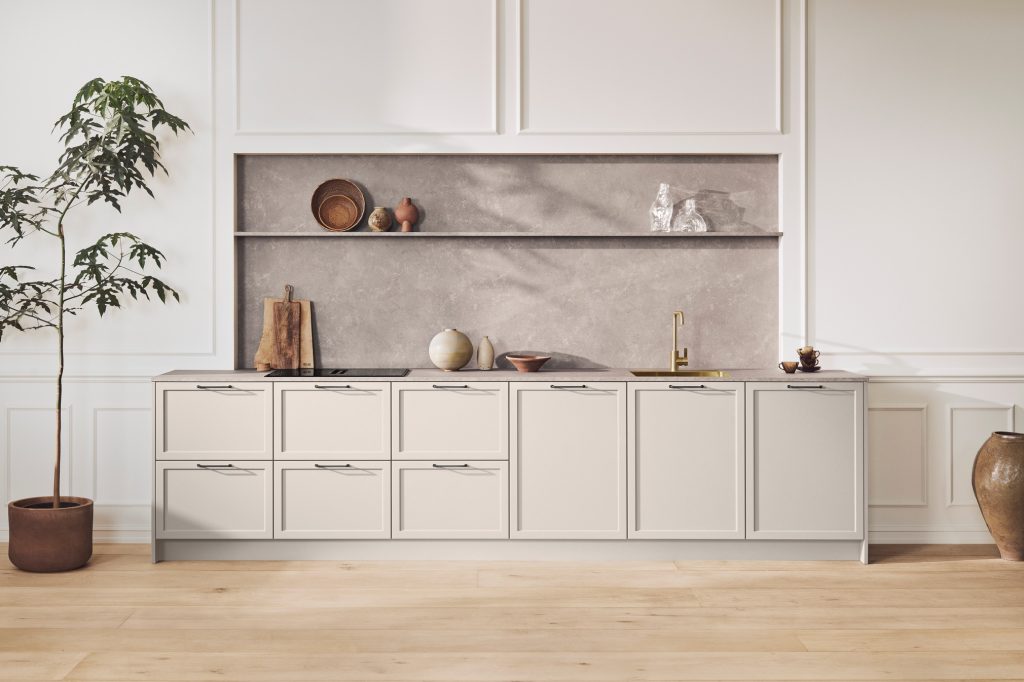
Which kitchen cabinet fronts are actually right for your space? It’s a bigger question than it sounds, because cabinet fronts, also called cabinet doors, cover more visible surface area than almost anything else in the room. Get them right, and the whole kitchen feels pulled together. Get them wrong, and no amount of styling fixes it afterward.
This guide walks through how kitchen cabinet fronts are built and mounted, what they’re made from, ten styles worth considering, and how to land on the right combination for your space, your budget, and Thailand’s climate. It’s real Danish design at surprisingly low prices: every front we make comes with a 10-year warranty and ships straight from our carbon-neutral factory in Denmark, so we’ve spent over three decades helping Thai homeowners work through exactly this decision.
What Are Kitchen Cabinet Doors (Fronts)?
Simply put, kitchen cabinet doors, also called cabinet fronts, are the outer panels attached to your cabinet boxes. They open and close to give you access to what’s stored inside, and because they cover most of the visible cabinetry, they do the heavy lifting on how your kitchen actually looks.
Main functions
- They form a barrier that protects stored items, house the hinges and hardware, and allow for easy access.
- They create the visible style of the kitchen, shaping whether it reads as modern, traditional, or classic.
How Are Cabinet Doors Built? Framed vs. Frameless, and How They Mount
Before you fall for a style, it’s worth understanding what’s underneath it. Construction affects cost, durability, and how the kitchen holds up over the next decade, not just how it looks on day one.
Framed vs. frameless cabinets
Framed cabinets have a face frame around the front of the cabinet box, with the door mounted onto or into that frame. Frameless cabinets, sometimes called European-style cabinets, skip the face frame entirely, so the door attaches directly to the box. So which is better for a Thai home? Frameless construction is the standard behind most Scandinavian kitchen design, including every Kvik cabinet, because it gives more usable interior storage and a cleaner, more continuous line across the front of the kitchen.
It’s also the thinking behind Kvik’s XXL and XL cabinets, which fit 15 to 40 percent more storage than standard cabinets of the same size, at little to no extra cost. Worth knowing before you fixate purely on the door style: what’s behind the front matters just as much as what’s on it.
How cabinet doors mount: overlay and inset
| Mounting Style | Coverage | Relative Cost | Best For |
|---|---|---|---|
| Full overlay | Covers almost the entire cabinet box, minimal visible frame | $ (most affordable, standard on Kvik cabinets) | Modern, frameless kitchens wanting a smooth, continuous front |
| Partial overlay | Covers part of the cabinet face, more frame visible | $ (lower installation cost) | Budget-conscious or more traditional layouts |
| Inset | Sits flush inside the frame rather than on top of it | $$$ (precision fitting required) | Furniture-like, custom-built kitchens |
For most Thai homes, we’d point you toward full overlay on frameless cabinets. It’s the easiest to keep clean, and it’s the most forgiving of the slight expansion and contraction that comes with humidity, which is exactly why it’s the standard across Kvik’s kitchen collections.
What Are Cabinet Doors Made From?
The material behind a cabinet door affects how it looks, how it holds up, and, in Bangkok, Phuket, or Hua Hin specifically, how well it copes with humidity. Here’s how the main options compare.
| Material | Humidity Performance | Maintenance | Price Tier |
|---|---|---|---|
| Foil-wrapped MDF (e.g. Kvik Veda) | High | Low | $ |
| Wood veneer | Medium, needs a quality sealant | Medium | $$ |
| Lacquered MDF | Medium, shows marks more easily | Medium-High | $$ |
| Solid wood | Lower, expands/contracts with humidity | High | $$$ |
In high-humidity locations, foil-wrapped or well-sealed veneer doors generally perform more consistently over years of daily use than uncoated solid wood, which is worth weighing alongside the look you’re after. It’s why Kvik’s Veda collection, in matt white, green, light oak, and dark oak, uses foil-wrapped construction as standard. That foil is made with PET-upcycled material, and every Kvik kitchen is up to 95 percent recyclable at the end of its life, so durability and sustainability aren’t really separate decisions for us.
10 Kitchen Cabinet Door Styles Worth Considering
Once you know how a door is built and what it’s made from, here are ten styles to help narrow down the look and refine your overall kitchen cabinet design.
1. Classic Danish Cabinet Doors
Danish-style kitchen cabinet doors focus on quality materials, simple proportions, and thoughtful finishes rather than decoration. There’s no excess detailing here. The design earns its visual weight through material choice and precision in the finish.
This is the approach behind Kvik’s own Veda collection, available in matt white, green, light oak, and dark oak. The fronts are built to work across different kitchen sizes and layouts without needing custom sizing for every project.
2. Wood-Effect and Natural Wood Cabinet Doors
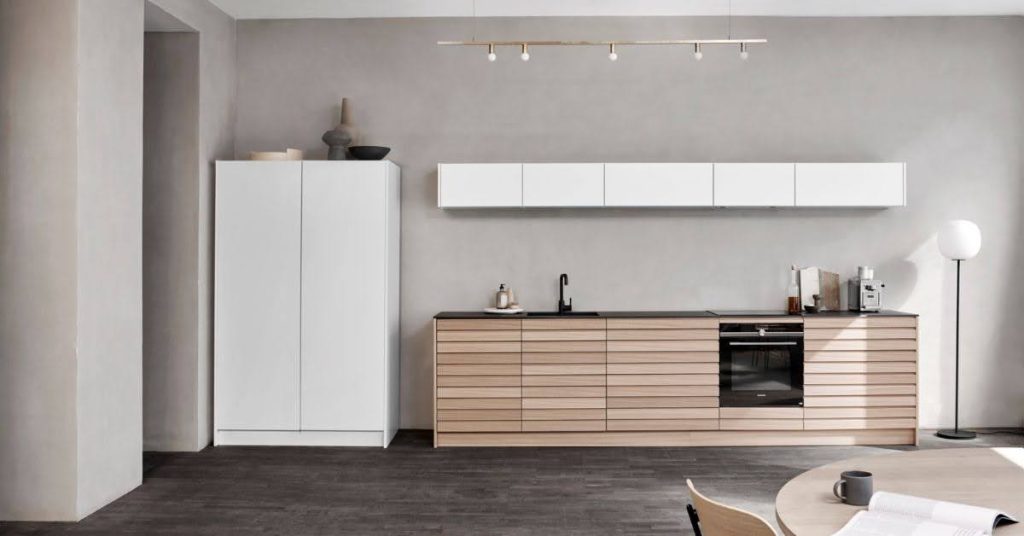
Wood-effect cabinet doors bring warmth into the kitchen. Light oak works well in Scandinavian or transitional spaces, while dark oak reads as more formal and dramatic.
Natural wood fronts age with use, which many homeowners actually prefer, and pair easily with stone or concrete worktops for a grounded, lived-in feel. Curious how far you can take the wood-tone pairing? Our wood kitchen design ideas guide goes deeper.
3. Shaker Style Cabinet Doors
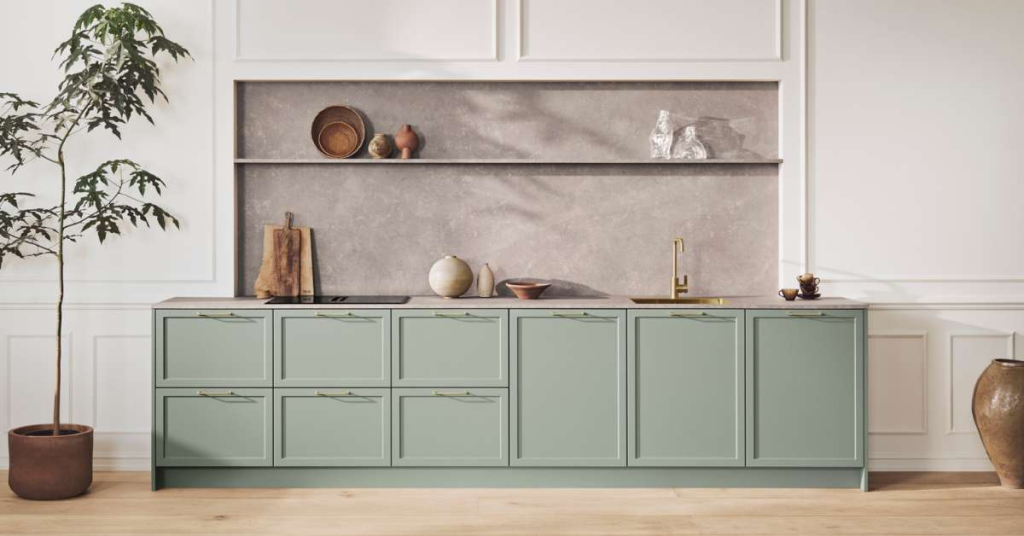
It’s worth mentioning Shaker doors, if only because they’re the single most searched-for cabinet door style worldwide. They’re built around a square frame with a flat, recessed center panel, and they show up everywhere from traditional to contemporary kitchens because the proportions rather than any decoration do the work.
That said, Shaker isn’t where Kvik’s own design language sits. Our collections lean into the clean, uninterrupted lines of Scandinavian design instead, so if the appeal of Shaker is its simplicity, you’ll likely find our handleless and flat-panel doors (below) scratch the same itch while staying closer to Kvik’s Danish roots. If you’re drawn to lighter, classic-leaning kitchens generally, our white kitchen cabinets guide is a better place to start.
4. Scandinavian Cabinet Front Doors
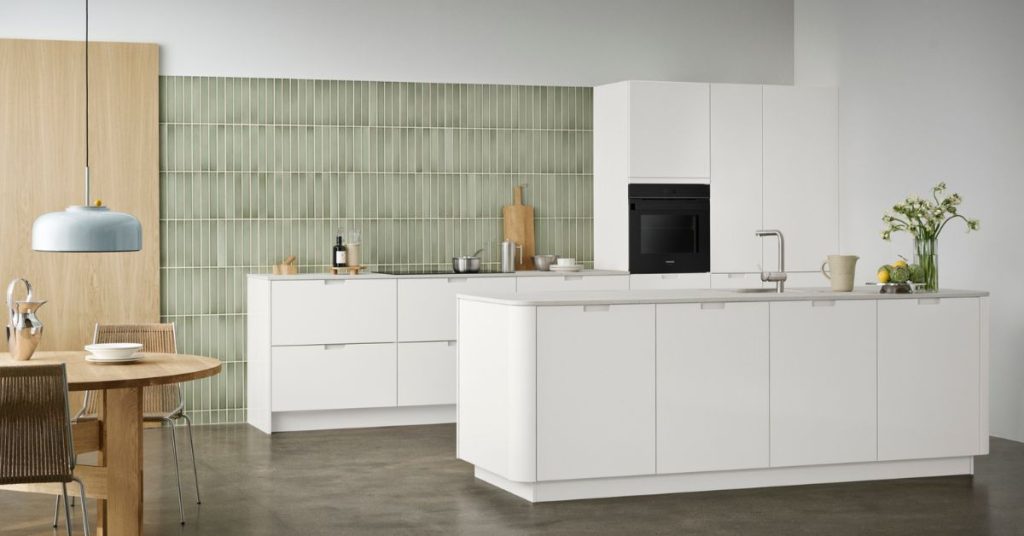
Scandinavian design usually takes a more understated approach, leaning on deeper tones and natural materials to build warmth, depth, and character rather than decoration.
Deep greens, charcoal greys, and dark wood finishes add real visual interest while keeping things calm and sophisticated, especially paired with lighter countertops or soft neutral walls. It’s the philosophy behind Kvik’s own cabinet door collections: shades inspired by nature, not passing trends. Leaning toward something darker? Our black kitchen design ideas guide is worth a look.
5. Handleless Cabinet Doors
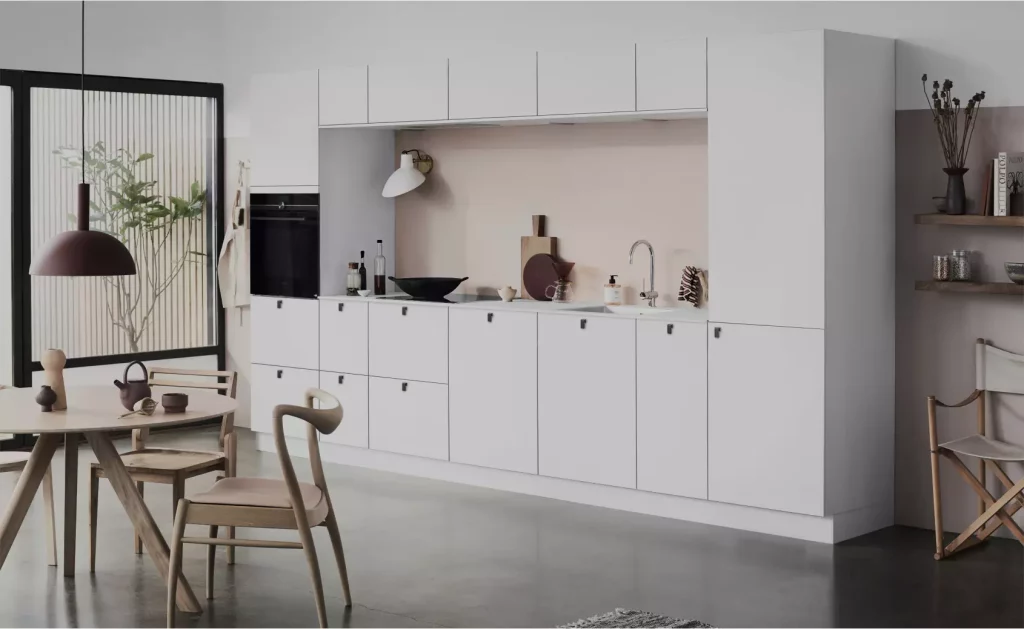
Handleless kitchen cabinet doors use recessed channels or push-to-open systems instead of separate knobs or pulls. The payoff is a sleek silhouette with fewer gaps where grease and dust collect.
It’s a calm, clutter-free look that works especially well in open-concept homes and smaller kitchens. It ages well too, since there are no handles to loosen or replace over time, and cleaning is faster with no protruding parts to work around.
6. In-Frame Cabinet Doors
In-frame cabinet doors give the kitchen a bespoke, furniture-like quality. The door sits visibly inside an outer frame, adding dimension and a sense of craftsmanship to the front face.
This style suits kitchens leaning toward a tailored, refined look rather than pure minimalism. It adds visual structure without heavy ornamentation and pairs well with classic hardware and natural stone worktops.
7. Hidden and Sliding Cabinet Doors
Modern kitchens prioritize efficiency, and sliding cabinet doors are a smart way to save space while keeping a sleek look. Unlike traditional hinged doors, sliding or folding designs tuck neatly away, ideal for compact kitchens, pantries, or utility areas.
Beyond the practical upside, they create a clean, contemporary aesthetic that keeps the kitchen feeling organized and streamlined, well suited to how most people actually live now.
8. Traditional Cabinet Doors
Traditional cabinet doors use raised-panel or moulded fronts, warm wood tones or painted neutrals, and decorative touches like crown moulding or glass inserts. The goal here is a timeless, detailed look rather than a minimal one.
This style tends to work best in larger kitchens, where there’s enough wall space for the detailing to actually read, since raised panels and moulding can feel busy in a small, tightly packed layout. It pairs well with warmer worktop materials like stone or butcher block worktops, and with brass or antique-brass hardware, which reinforces the classic feel rather than fighting it.
9. Glass-Front Cabinet Doors
Glass-front cabinet doors have a glass insert or full glass panel that shows, or softly reveals, what’s stored inside. They’re often used as an accent on upper cabinets, since they add light, depth, and a decorative feel without opening up the whole kitchen.
You can display dishware, glassware, or decorative pieces behind clear or frosted panes, and some homeowners add integrated lighting behind the glass for a warm evening glow. Since open or glass storage shows everything inside, it works best paired with closed cabinet doors elsewhere in the kitchen, so everyday clutter stays out of view. Frosted or fluted glass is a good middle ground if you want the texture of glass without full visibility into the cabinet.
10. Beadboard Cabinet Doors
Beadboard cabinet doors have a beaded, grooved panel, usually vertical slats, set inside a framed door. They give kitchens a charming, slightly rustic character and show up often in farmhouse, cottage, coastal, and modern-vintage kitchens.
Beadboard doors generally feel casual and welcoming rather than formal. White beadboard is the most common choice for a clean cottage or coastal look, while darker wood tones or painted colors push the style toward more traditional or rustic. One thing worth knowing: because the grooved surface has more texture than a flat panel, it tends to collect slightly more dust and grease over time, so it suits kitchens where you don’t mind a bit more regular wipe-down versus a fully flat, low-maintenance front.
How Do You Choose the Right Cabinet Doors for Your Kitchen?
With ten styles and several construction and material options on the table, how do you actually narrow it down? In our experience, it comes down to three practical questions.
- How much maintenance are you genuinely willing to do? Handleless, flat-panel, and foil-wrapped doors are the easiest to keep clean. Beadboard, raised-panel traditional doors, and solid wood ask for more regular attention, especially in Thailand’s climate.
- What’s your budget? Foil-wrapped full overlay doors, like Kvik’s Veda collection, generally offer the most value. Inset construction and solid wood cost more, largely because of the precision fitting and material involved.
- What’s the size and light of your kitchen? Light colors, handleless fronts, and flat panels open up a small kitchen visually. Larger kitchens have more room to carry off detailed traditional or in-frame doors without feeling busy.
Worth planning cabinet doors alongside kitchen drawer ideas and worktop material rather than separately, since all three define the finished look together. And if you’re still not sure where to land, a private design consultation with a Kvik designer is the fastest way to see samples of each material and finish in person before deciding.
Design Your Kitchen with Kvik
Ten styles, three mounting types, four materials: it’s a lot to weigh on your own. Kvik offers a range of kitchen cabinet fronts and cabinet doors built to suit different tastes, budgets, and kitchen sizes, from classic Danish flat-panel doors to handleless options, bold color fronts, and natural wood finishes. Every door comes from our carbon-neutral factory in Denmark and is backed by a 10-year warranty on cabinets and doors, with 25 to 35 years of coverage on moving parts.
We design around what we call SociableKitchen®, the idea that a kitchen works best as the social heart of the home, not just a place to cook. The cabinet fronts you choose set that tone before anything else does. And once you’ve decided, you’re not waiting long: most orders ship from stock at our Bangkok warehouse within 2 to 3 weeks.
Contact us to book a free private design meeting with a Kvik designer, and let’s start planning your kitchen together.
Frequently Asked Questions
What is the most popular kitchen cabinet door style?
Shaker-style cabinet doors are the most searched-for style globally, thanks to their simple, versatile frame. Kvik’s own collections lean toward clean Scandinavian and handleless designs instead, which tend to suit humid climates and open-plan Thai homes particularly well.
What's the difference between overlay and inset cabinet doors?
Overlay doors sit on top of the cabinet frame and are the most common and affordable mounting style, including on Kvik’s cabinet range, while inset doors sit flush within the frame for a custom, furniture-like look that typically costs more due to the precision fitting required.
How do I update my kitchen without replacing all the cabinets?
Replacing only the cabinet doors and fronts is one of the most cost-effective updates. You keep the existing cabinet boxes and change only the visible parts, which refreshes the whole kitchen at a lower cost than a full replacement.
What cabinet door materials hold up best in Thailand's climate?
Foil-wrapped doors, like those in Kvik’s Veda collection, and well-sealed veneer generally perform more consistently in humid conditions than uncoated solid wood, which can expand and contract more with humidity changes.
What kitchen cabinet door ideas work in small kitchens?
Flat panels and handleless fronts in light colors work best. They reduce visual clutter and reflect light, making the kitchen feel more open and less crowded.
Can I mix cabinet door styles in one kitchen?
Yes. Mixing cabinet door styles in one kitchen is increasingly common in modern and luxury kitchens. The key is intentional contrast, such as pairing a handleless upper cabinet with a wood-effect lower cabinet, while keeping the overall palette cohesive.
